
ALASKAN IGLOO TALES
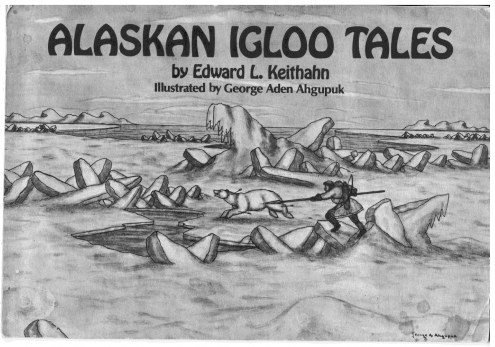
"Alaskan Igloo Tales" (1976) originally illustrated in black and white by George Ahgupuk.
This collection of stories and illustrations is rooted in a book Tamara received decades ago: the 1974 edition of "Alaskan Igloo Tales." At first, the stories seemed distant—irrelevant to her life and to the realities of her community at the time, in Nome, Alaska. Yet as the years passed and she faced personal, professional, and family challenges—and sought to heal her inherited Native (Inupiaq) trauma—she found herself drawing on a range of emotional, metaphysical, psychological, and artistic skills, sometimes casual and sometimes desperate, to navigate the situations unfolding around her. Likewise, she dusted off the original "Alaskan Igloo Tales" book, and, over time, found that the teachings and meanings within these tales began to reveal themselves in unexpected ways. The practical, moral, spiritual, fantastical, and psychological lessons she gleaned from these stories are deeply inspired by her studies of the teachings of Joseph Campbell, Carolyn Myss, Jiddu Krishnamurti, David R. Hawkins, and even the Bible.
Forward:
My intention for this volume, with respect to the written content, was to insert contemporary Inupiaq spellings where Edward L. Keithahn, in my black-and-white 1974 copy of “Alaskan Igloo Tales,” wrote them phonetically. However, my initial consultation with Native speakers and linguistic resources proved this to be a difficult, if not impossible, task. Keithahn was a teacher in Shishmaref in the 1920s and 1930s who collected (and possibly recorded) these traditionally oral stories. As a non-Native, he wrote them down before contemporary Native Alaskan orthographies were established decades later. As a result, he rendered Inupiaq and Yupik names, places, words, and phrases phonetically, using the English alphabet. Languages, to be properly heard with their subtle distinctions, require more exactness than a casual listener can provide. Keithahn’s English ears, for example, heard the name A-puk-een-a. Today, A-puk-een-a is likely spelled Apukiina, but Apuquiina, Apukina, and Apuqina are possible. Keithahn’s Oo-goo-gor-o-seok may miss the ġ, which is formed farther back in the throat than how he implies here with a hard g, as in goose. He may have missed the ŋ (g+n) vocal altogether. Oo-goo-gor-o-seok, therefore, could possibly be Uġuŋŋuruusiq, or Ugunġuruusiq. That he took the trouble to gather and record these stories, and to have them illustrated by George Ahgupuk, shows that Keithahn was deeply fascinated by them and understood their historical importance. Even though I have had to reluctantly conform to his phonetic spellings, I am grateful to him, as these stories have shaped my art practice for decades and, I hope, will continue to do so for many years to come.
Tamara Ann Burgh (Swede/Inupiaq-Kawerak)
ALASKAN IGLOO TALES by Tamara Burgh can be purchased on LULU.COM
See more on FACEBOOK and INSTAGRAM
![]() |
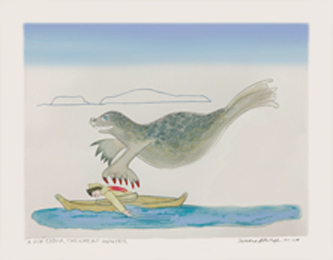
"Apukeena"
|
|
![]() |
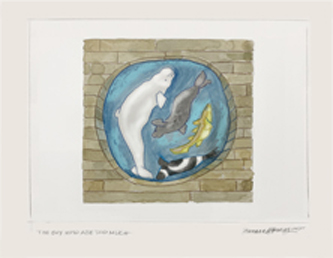
"The Boy Who Ate Too Much"
|
|
![]() |
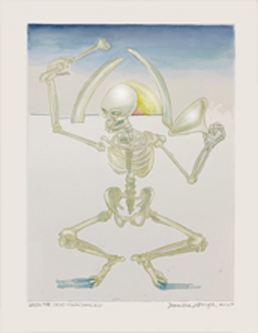
"Dancing Dead Man" |
|
![]() |
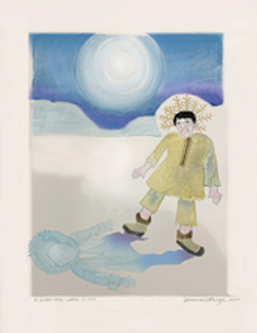
"Ezummollookoon" |
|
![]() |
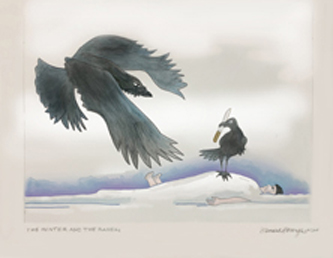
"The Hunter and the Raven" |
|
![]() |
"Kinaleek" |
|
![]() |
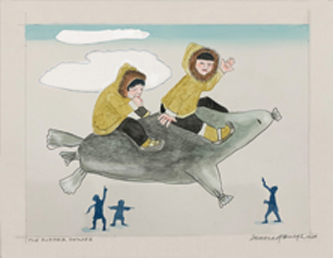
"The Robber Dwarfs" |
|
![]() |
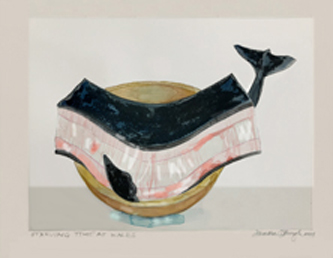
"Starving Time At Wales" |
|
![]() |
"The Dwarfs" |
|
![]() |
"The Traders" |
|
![]() |
"Two Orphans" |
|